Showing posts with label Eichenauer. Show all posts

Thursday, August 10, 2023

Life was Fragile in 18th Century Tann

 Life in Hessen in the 18th century was hard for the common people. The healthcare that we take for granted was unknown and people did not understand the effect of unsanitary conditions on their health. As I was transcribing the death records from Tann, the circumstances of one individual seemed to epitomize the difficulties faced by every family in Tann. This is her story:

Anna Christina Vockerod was born in Tann and baptized in the Lutheran Church on 21 January 1703.

When Anna Christina was 23 years of age, she was married to Henrich Bold, who was 7 years her senior. 


Marriage record of Henrich Bold and Anna Christina Vockerod


In due course, they had two sons born to them: Johannes, born on 29 April 1727 and died 6 days later; and Johann Andreas, born on 5 April 1728 and died 27 days later. Her husband, Henrich Bold, died later that same year, on 15 October 1728, at age 32, leaving Anna Christina bereft — a widow at age 25 after just 2 years of marriage.


Two years later, on 10 January 1731, Anna Christina married Johann George Knebel, who was just 7 days her senior. Their births are recorded consecutively. on this page.

Birth records of Johann George Knebel and Anna Christina Vockerod


Marriage Record of Johann Georg Knebel and Anna Christina, widow of Henrich Bold


Together, she and George also had 2 children, Anna Martha, born 26 October 1731 and Johann Tobias, born 18 July 1734.


[Sidebar: Her daughter from this second marriage, Anna Martha Knebell, married Johann David Hoßfeld and had 3 children. One son, Johann Tobias Hoßfeld, married my 4th great-aunt, Anna Dorothea Rödiger (daughter of my 4th great-grandparents, Johann Adam Rödiger and Barbara Elisabetha Bettenhausen). So, this is how I became aware of Anna Christina Vockerod’s story.]


But, Anna Christina Knebell and her second family suffered another series of deaths that typifies the difficult living conditions of 18th century Hessen: On 30 December 1760, Anna Christina died at age 57.

Death Record of Anna Christina Bold-Knebel, neé Vockerod


Three weeks later, on 20 January 1761, her second husband, Johann George Knebell died.

Death record of Johann George Knebel (aka Knöbel)


Four days after that, on 24 January, their son, Johann Tobias died, age 26.

Death record of Johann Tobias Knebel (aka Knöbel)


Three weeks after her brother’s death, on 17 February, Anna Martha, age 29, was also struck down, leaving her husband with two children, ages 4 years old, and 11 months old.

Death record of Anna Martha Hoßfeld, neé Knebel


To put all of this into perspective, Anna Christina lost her first husband and both of their children within 2 years and 4 months of their marriage. Her second husband, and their two children all died less than a month and a half after her own death. And within that 45 day period, 27 other residents of the tiny villages of Tann and Rohrbach also died.


In the church records, there is no mention of the nature of their deaths, nor is there any expression of surprise at the closeness of the times of their deaths to one another. Death was a familiar face in Tann, often the result of disease which could run rampant through a family or even through a village.


As the life of Anna Christina Vockerod illustrates, our ancestors in Hessen often fought a losing battle when it came to raising families. Death by disease ate away at every family. Hopefully, this peek into one woman’s family has given you an idea of the circumstances faced by our 18th century ancestors.


--Stephen

Wednesday, December 28, 2022

Recap of Research from 2020-2022, pt.2

Headline: A Dis-Entanglement Project Leads to New Discoveries!

I have often referred to a dear fellow collaborator, Regina Hiller, as my Genealogy Angel. She is a fountain of knowledge and always willing to answer all my questions, help transcribe the illegible scribbles of the Church records and make comments on people in my Ancestry.com tree when she finds a birth, marriage or death record that I do not have.

A week ago, Regina made a comment on a fellow by the name of Johann Conrad Möller, a resident of Niederthalhausen, where the Eichenauers also lived and worshiped for generations. Her comment was, “probably identical with Hanß Curth Möller”. This led me to look for the Hanß Curth Möller in Niederthalhausen that she was referring to.

I discovered, to my immediate dismay, that I had 3 gentlemen named either Hanß Curth (old form) or Johann Conrad (new form) in Niederthalhausen who married within just a few years of each other (in the 1740s), and I had several more that had been included in my tree because they were mentioned as the father of a particular child when he or she was either baptized or married that could have been one of these three men.

I do not like loose ends, especially when it means that I have multiple instances of the same person appearing separately in my tree. So, I set about the task of straightening it all out. It took me an entire week, about 100 file cards, the perusal of two Church books covering 150 years and a lot of deduction. But in the end, my tree is all the better for it.

To be quite honest, not a single one of these Johann/Hanß Conrad/Curth Möllers is a blood relative. All this is background for the real story:

We do have a Hanß Curth Möller from Niederthalhausen in our family linage. He is my 7th great-grandfather. He did not originally become involved in the Dis-entanglement Project, because he was clearly from an earlier generation. You may be able to figure out your relationship with him from the following:

Hanß Curth Möller was the father of Anna Catharina Möller, who was the mother of Johann Michael Mürer, who was the father of Anna Christina Mürer, who was the mother of Johann Konrad Eichenauer, who was the father of Anna Margretha Eichenauer (wife of Johann Tobias Rödiger) and of Johann Friedrich Eichenauer (husband of Anna Katharina Rödiger).

So if you are an Ohio Roediger, you are descended from Anna Margaretha Eichenauer, and if you are an Ohio Eichenauer, you are descended from her brother, Friedrich. From there, hopefully, you can pick up the thread that leads back to you. If not, send me a comment, and I will see what I can do to clarify their relationship to you.

What I knew about Hanß Curth Möller a week ago wouldn’t have filled a thimble. I knew that he was the father of Anna Catharina Möller. I knew that he was buried in Niederthalhausen on 27 March 1735, age 74 years, 6 months. So, I also knew that he was born about September of 1660 because of his age at death. I did not know the name of his wife or when they were married. Nor did I know his specific birth date, where he was born, nor the names of his parents. I also did not know anything about any of his other children.

The problem is that the Church books in Niederthalhausen don’t begin until 1686, so it is hard to connect the dots between Möllers who were born, married or died prior to that date. BUT, as a result of the Dis-entanglement Project, I remembered that there are Niederthalhausen Church records imbedded (and hidden) in the Beenhausen Church book covering the years 1649-1684, as well as records for Oberthalhausen and 6 other villages besides Beenhausen.


Map is from the Meyersgaz.org website

Niederthalhausen is marked by the red dot. Oberthalhausen is to the west and designated simply as "Ob".


Hanß Curth Möller's baptismal record: "am 28 7bris" (28 September)

Once my Möller Dis-entanglement Project led me to this Church book, I discovered that our ancestor, Hanß Curth Möller was born in Oberthalhausen, not Niederthalhausen. Although Hanß Curth Möller's father's name is mentioned in his baptismal record, it is difficult to read and I am uncertain what it was. But my best guess is that his father's name is Hans Möller.

His baptism in Oberthaalhausen  prompted me to examine the Oberthalhausen Church book and, in turn, led me to discover that Hanß Curd was married in Oberthalhausen in 1693 to Catharina Beißheim.

"Anno 1693, am 27. Aprilis ist Hanß Curd Möller und Catharina, Peter Beißheims von Niederthalhausen, nachgelaßen Tochter copuliert word" (on 27th of April, in the year 1693, Hanß Curd Möller was married to Catharina, the daughter of the deceased Peter Beißheim of Niederthalhausen)


I also discovered that his first three children, including his daughter, Anna Catharina (our direct ancestor) were born in Oberthalhausen, and the last two (that I am aware of) were born in Niederthalhausen.

Armed with this information, I was able to find Catharina Beißheim’s birth, confirmation and burial records; as well as the marriage record of her parents on 9 February 1654 in Niederthalhausen, which revealed her mother’s name to be Eulalia Weckman, daughter of Martini Weckman. Her father, Peter Beißheim’s burial record reveals that he was buried on “Dom. Sexagesima”* in 1686 in Niederthalhausen, age 70. This puts his birth at about 1615-1616. At the time of his death he was serving as Mayor of Niederthalhausen and church warden. 

 *Sexagesima is a Sunday roughly equivelent to 60 days before Easter on the Church Calendar and happened to fall on the 7th of February in 1686.

Peter Beißheim’s wife, Eulalia, was buried on 4 March 1684, at age 52. This puts her birth about 1632.

So, putting it all together, I am very happy to announce that the Eichenauer-Roediger linage has been extended once again and I now add another identifiable 9th great-grandfather to my Tree. The following chart provides the details. The Relational Notations below each name in the chart refer to that individual's relationship to me. But, using the linage information previously provided in this Blog post, you can determine their relationship to you.


I am very pleased to have been able to learn so much about our ancestors over the last 10 years. As we close out 2022, I wish all of my cousins, both in the USA and in Germany, all the best in 2023.
--Stephen Roediger

Recap of Research from 2020-2022, pt. 1


I note with some frustration that I have not posted a blog in over two years. Believe you me, it is not because I have set the research aside. Rather, it is because I have been deluged with information since the big bad COVID struck.

This is in the main due to new collaborators appearing in my life. In 2020, I  received a message from Natalie Apel. She was born in Rohrbach, just 3/4 mile from Tann but now lives close to Hamburg. She had an interest in learning about her ancestors, so we began corresponding. We quickly discovered that we are related at least 3 different ways. Her father's father is my 7th cousin. And her father's mother is my double 5th cousin. I will spare you the details, but suffice it to say that we have had a lot of ancestry to discuss and have kept in close contact.

Natalie, and her father, Helmut Apel

***********************************************************************

In November, 2021 I contacted Scott in Tennessee. He is a descendant of Emil Grosse, the  brother of George Roediger's second wife, Anna Augusta Grosse. He had posted some very helpful documents about the Grosse family on Ancestry.com. With his help, I was able to learn more about the Grosse family. That, in turn, helped me solve the riddle about how George Roediger, living in Auglaize Co. and Mercer Co. Ohio met his wife, a German immigrant residing in German Village in Columbus, Ohio.

Scott and Kay Dawson

***********************************************************************

In May of 2022, I came in contact with Dawn, a researcher from Albany, NY, who answered a query I made about Rixfeld, the earliest known location of our Eichenauer ancestors. She answered and said she didn't know about Eichenauers, but her family came from Rixfeld. After a little collaborating we discovered that she is my 9th cousin, twice removed (specifically, her maternal grandmother is my 9th cousin, and the connection goes all the way back to the tippy top of my Eichenauer tree when the Eichenauers lived in Rixfeld.

Dawn Maynus

***********************************************************************

Also in May, or early June, I was contacted by Birgit, who was originally from Schwarzenhasel, but now lives close to Kassel. She was searching online for research pertaining to her home town and discovered my Blogposts on the Diegels of  Schwarzenhasel. After corresponding with her, I learned that her father, Heinrich, is my double 8th cousin. 

Heinrich, Irmtraud and Birgit Marth

It was Birgit’s mother, Irmtraud, who provided the key to unlock the door to completing my research of the Rödigers in Tann. I soon learned that Irmtraud had extensively researched the Schwarzenhasel community and was a major contributor to a book that I already had in my possession, Chronik Schwarzenhasel: Ein Dorf im Wandel der Zeit. But her knowledge goes way beyond the bounds of Schwarzenhasel. I told her that I had exhausted the records in Tann searching for the connection between Henn Rödiger, who is listed in the book 650 Jahre Tann as a farmer with at least 1 horse or ox in 1627 and my 6th great-grandfather, Jost Rödiger, who was born about 1657 and married in 1679. She asked if I had ever heard of the Kopialbuch of 1659. She explained that it was like a census taken of more than thirty villages in the Rohbachtal. The head of each household is listed along with the name of his wife, children and other relatives living in his home. Tann was among these villages, and only one Rödiger family lived in Tann in 1659:

According to the Kopialbuch, the Rödiger household included:

Conrad, head
Margretha, his wife
Johannes (listed as confirmed in the church, so at least 12 or 13 years old)
Justus*
Elisabeth
Catharina
as well as a “Hausgenoßin” (houseguest) also named Catharina.

*Note that “Justus” is synonymous with the name “Jost”. Suddenly, everything clicked, and the Rödigers that I hadn’t been able to connect to the family were included in this list and were Jost/Justus’s siblings.

Once I knew that the “loose ends” were Jost Rödiger’s siblings, then, based on their ages at death, I was able to deduce that their father, Conrad must be the son of Henn Rödiger, the owner of livestock in Tann in 1727.

Every last Rödiger in the Tann church records has now been accounted for.

Prior to any knowledge of the Kopialbuch, I had traced back another part of my ancestry to a Jeorg Büttner who married an Elisabeth Rödiger in 1670. They were my 7th great-grandparents. But without the Kopialbuch, I could not have been certain how Elisabeth Rödiger fit into the family. Now, because of the Kopialbuch, I know that Elisabeth is not only my 7th great-grandmother, she is also the sister of my 6th great-grandfather, Jost Rödiger.

Here is a diagram of the first 4 generations of the Rödigers of Tann:

The Rödiger siblings, Elisabeth and Johannes, were married in a double wedding to Büttner siblings, Jeorg and Catharina.

Johannes Rödiger had only one son, Johann Conrad. And Johann Conrad had 4 children, all girls. So along Johannes’ line the Rödiger name died out and was only continued on through our common ancestor, Jost/Justus.

There is one other significant breakthrough to report, but I will save that for a subsequent Blogpost. Until then …


Wednesday, November 18, 2020

The Mysterious Jeremias Eichenauer

 I first came across the name, Jeremias Eichenauer while researching our Eichenauer family in the Niederthalhausen church death records. What made him unique was that he was a disconnect. All of the other Eichenauers in Tann and Niederthalhausen were related and descended from Johann George Eichenauer and Anna Katharina Schäfer who had moved to Niederthalhausen in about 1790.

But not Jeremias. He was a kind of Eichenauer Melchizedek. Well, that is not exactly true, because Melchizedek was "without father or mother, without genealogy, having neither beginning of days nor end of life" (Hebrews 7:3). Jeremias definitely had an end of life, as the records prove. But like Melchizedek, Jeremias just seemed to appear in Niederthalhausen from nowhere.

He has now sat in my Missing Persons file for several years. In fact I had quite forgotten about him until this week while compiling data on the Eichenauers from Frischborn in an attempt to find a connection with our Niederthalhausen ancestors. This is quite a different location from the subject of my last Post, which concerned the Eichenauers of Friedewald. Just saying it so you won't get the two confused.

While in the Frischborn records, I came across a Jeremias Eichenauer and the name sounded familiar. So I dug through my Missing Persons file and sure enough, the information matched.

I then discovered that his father, Johann Henrich and his grandfather, Konrad Eichenauer were born in Rudlos. This is also where our ancestor, Georg Eichenauer was born (his son being Johann George, who moved to Hof Trunsbach about 1790).

This map helps me to see what I think of as the "Cradle of Eichenauer-ization":


Now back to Jeremias Eichenauer's death record from 1853. I captured four columns in two images to make it more legible for those of you who are into reading the old German script.


The first column identifies the deceased, tells us what his occupation was and to whom he was married. The second column reveals when and where he was born.

Name: Jeremias Eichenauer
Occupation: freiherrlich Riedeselischer Forstlaufer (Forest Ranger of the Baronial family Riedesel)
Spouse: Catharina Köhler aus (from) Bessungen bei (near) Darmstadt
Birth place: Frischborn bei (near) Lauterbach
Birth Date: 16 Dezember 1801

The third column provided the date of death, and the fourth column the date of burial.

Date of death: am zwei und zwanzigsten März, Mittags 12 Uhr (on 22 March [1853], at noon)
Date of burial: am 25 März, Nachmittags 2 Uhr (on 25 March [1853] at 2 p.m.).

I have created a map which shows the 24 locations in Germany where I have found Eichenauers relevant to my research. Each is marked with a teal colored pin:
Jeremias Eichenauer's birthplace in Frischborn is one of the cluster of pins circled in red. I believe that all of the different Eichenauer families may yet be traced back to locations within that small circle. Hence "The Cradle",
The birthplace of his wife is nearly 70 miles to the south in a "suburb" of Darmstadt called Bessungen. Which begs the question, how did they ever meet? ... I'm still working on that one, but I have a theory. More on that later in this Blog Post.

On the map below, I have zoomed in so you can see the location of his birth and of his death:

And the distance between the two locations begs another question, "How did Jeremias Eichenauer end up dying in Niederthalhausen, 30 miles north of his birthplace, Frischborn?" He certainly got around.

To answer both of those questions, it has helped to learn a bit about the Riedesel family.

Baron Riedesel's "home" was in Eisenbach, just 1.5 miles west of Frischborn. In this case it is really true that his home was his castle--Schloss Eisenbach.
Here is a satellite view of the grounds:

If you want to get a closer look on Google Maps just type "Schloss Eisenbach-Lauterbach" into the search bar. And there are plenty of photos of the castle that you can view online. I am resisting copying any of them here because of copyright restrictions. I must say it is a very impressive place. On the right of the photo above you can see the castle and even some of the outer wall fortifications which are still in existence. I understand that there is a bike path that runs directly beneath these walls, so if you are up for a little pedaling, check it out sometime.

The Freiherr (Baron) owned a number of properties, and if you will recall, the Riedesel family owned Hof Trunsbach near Niederthalhausen, where our common ancestor Johann George Eichenauer served as General Manager from about 1790 until his death in 1822. That position was held by him or one of his male descendants for nearly one hundred years.
In case you missed it you can check out my blog post The Book Has Arrived where I posted a photo of Hof Trunsbach and briefly described it's significance to our family.

As I explored Jeremias Eichenauer's life (and believe me, tracking down a Forest Ranger isn't easy) I discovered the following facts:

17 July 1842--Jeremias Eichenauer and Catharina Köhler were married in Frischborn

But before they were married, their first son, Johann Georg, was born in Bessungen on 7 February 1839. (No that is not a typo. Georg really was born 3 years before his parents were married). What you should note is that apparently Jeremias had spent some time in Bessungen and this is probably where he and Catharina Köhler met. Her father, Adam Köhler was a "Dragoner in den Gard Regiment Chevaux" when his daughter was born in February of 1812 in Bessungen. This was an elite regiment of mounted horsemen under Napoleon. Napoleon was pretty much ousted from Germany by the end of 1813. Later, when Catharine married in 1842, her father's occupation was Schuhmacher (shoe maker) in Bessungen.

Bessungen originally was a separate city near to Darmstadt, but by 1888, had become surrounded by and incorporated into the free city of Darmstadt. This seems likely to be important to our understanding of what had brought Jeremias Eichenauer to the Darmstadt area.

First, it should be understood that the senior member of the Riedesel family was automatically a member of the First Chamber of the Estates of the Grand Duchy of Hesse. The Grand Duchy was a governmental body divided into three provinces, one being Starkenburg with its capital at Darmstadt. So, it was necessary for Baron Riedesel to travel the 70 miles to take part in the sessions.

I was hoping to learn Jeremias' occupation at the time of his first son's birth in Bessungen to see if there was a clue to what brought him to the big city, but sadly, the writing is so small on his baptismal record that I cannot make it out.

However, when sons, Adam (b. 1843) and Heinrich (b. 1847) were born, the family was living in Lauterbach (which if you refer back to the first map on this blog post, you will see that it is just north of Frischborn) and more importantly within spitting distance of the castle. And on both of their baptismal records, their father is reported to be a Kutscher (coachman).

Here is what I am thinking. Baron Riedesel often had to travel between Schloß Eisenbach and Darmstadt on government business. A man of his standing would no doubt travel in a comfortable coach rather than on foot or horseback. So, maybe, just maybe, Jeremias Eichenauer was one of his coachman, taking him back and forth between Eisenbach and Darmstadt. And what would a coachman do to kill time, days on end, while waiting for his employer to finish his business and return home? Wander around town, stop in a coffee shop, meet a nice girl. Could happen.

So, Johann Georg is born in 1839 in Bessungen bei Darmstadt. His parents return to his father's hometown of Frischborn and are married there in 1842.
Sons Adam and Heinrich were born in the neighboring village of Lauterbach in1843 and 1847 respectively.

Then something seemingly strange happens. A baptismal record appears for a son, William, born in 1851. The baptism is recorded in the Frischborn church book, but it says that William was born and baptized in Niederthalhausen. Hey! That's OUR hometown.
When I looked in the Niederthalhausen church records, sure enough, there it was:

This one I will spare you, and just translate and summarize:
On 4 June [1851] at 4 a.m. Wilhelm Eichenauer was born to Jeremias Eichenauer, the "Forest Ranger" of Baron Riedesel of the Grand Duchy of Hessen, and his wife Catharina neé Köhler, born in Beßungen near Darmstadt in House #10 in Niederthalhausen. The child was baptized in the same year on the 22nd of June in Niederthalhausen.

So, sometime between the births of their third and fourth children, Jeremias was moved from being a coachman for the Riedesel Family to being a guardian of the Riedesel Forests which, it seems, required them to move to the rural town of Niederthalhausen.

Here, Jeremias would have met our whole Eichenauer clan. Was he aware of their existence before being transferred there or was it a complete surprise? Did they suspect that they were related or did they have knowledge of a clear relationship?

Did you notice that I made the House Number bold? There is a reason for that. This house belonged Johann Heinrich Eichenauer, grandson of our common ancestor and Conductor of Hof Trunsbach, Johann George Eichenauer. Nine of his children were born in that house between 1826 and 1845. Their daughter, Anna Martha Christina died there in January of 1847. Then the family packed up and emigrated to Butler County, Pennsylvania in August, and their 12th child was born there in December of that same year.

So, that was 1847. The same year that Jeremias Eichenauer's son Heinrich was born (10 May) in Lauterbach. I have no clues as to the exact date when Jeremias moved to Niederthalhausen, but they could have moved into Haus 10 as early as September of 1847, and it was certainly no later than June of 1851.

Less than two years later, when Jeremias was 46 years old, he died in Niederthalhausen on 22 March 1853, leaving behind his wife and four sons, Johann Georg, age 14; Adam, almost 10; Heinrich, almost 6; and Wilhelm, age 21 months.

Among my records I found that Jacob Heinrich Eckhardt took possession of Haus 10 shortly after Jeremias' death. The birth of his son, Johann Adam took place there in June of 1854, two other children were born there in 1858 and 1860, and Jacob Eckhardt's mother died there in 1857. And just to show my thoroughness, 8 of his grandchildren were born in that house between 1876 and 1888.

From this it is clear that Jeremias' wife, Catharina, left Niederthalhausen soon after his death and returned with her boys to her hometown of Bessungen. Her oldest son, Johann Georg, died there in 1858 at the age of 19, Adam married there in 1871 and  at least two of his children were born there.

Catharina died on 7 June 1878 at the home of her son Heinrich, at Weinbergstraße 19, Bessungen.

The fate of Heinrich and William are yet to be discovered, if and when the records of Bessungen for the years after 1875 have been made available. But I checked the Darmstadt phone directory and found listings for three Eichenauers with landlines. So it appears that the Jeremias Eichenauer line may still exist.

At least some of the mystery surrounding Jeremias Eichenauer has been removed and I feel happy that he is no longer part of the Missing Persons file. I am still hopeful that more may  be revealed. You just never know what the spade will turn up next you keep digging.

Reporting from Geosynchronous orbit above Hessen-Darmstadt,

Stephen Roediger


Monday, September 7, 2020

Correction Concerning George Rödiger

Now that I am retired, I have been working hard on creating a database of abstracts from the Church records of Tann, Hersfeld-Rotenburg, Hesse.
I have completed the goal of abstracting the marriage records from 1830-1850 and connecting as many of those couples to my tree as possible.

Currently, I am working on the baptismal records from the Churchbook covering 1830-1909.

My immediate goal is to abstract the records from 1830 through 1850, then add all of these children to their parents in my Family Tree on ancestrydotcom. It is taking me about 2 hours to abstract the records for each year. At this moment I am finishing the year 1837.

Which brings me to the reason for this Blog post: I found an error in a baptismal record that I have already placed in my tree on Ancestry and I want to set the record straight.

The record is for George Rödiger, but probably not the George Rödiger our USA Roedigers are familiar with. This George is the son of Justus Rödiger, the son of Johann Heinrich Rödiger and Anna Sidonia Schneider. Johann Heinrich and Anna Sidonia were also the parents of Johann Tobias Rödiger. And he should be very familiar to any Roediger or Eichenauer in Ohio who has been following this Blog. Johann Tobias first married Anna Eva Heÿer and together they had Anna Katharina Rödiger who married Johann Friedrich Eichenauer, progenitors of the Eichenauers in Ohio. After the death of Anna Eva Heÿer, Johann Tobias married Anna Margaretha Eichenauer (Johann Friedrich's sister) and together they had (among others) Justus, father of John Henry who came to Ohio; George, widower, who brought his four children to Ohio, then married Anna Grosse; and Conrad Tobias who came to Ohio as a 15 year old boy.

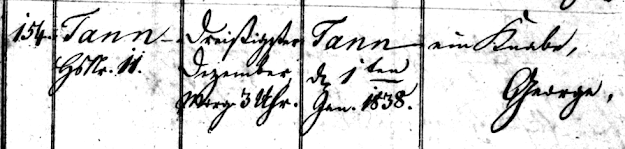
So, George Rödiger, of the corrected baptismal record, was a first cousin of those I highlighted in red, above. And here is the image of the first 5 columns of his baptismal record.


I mis-translated the date "dreißigster Dezember" as 17. December. It should be translated "30". If it had actually been the 17th, it would have been written "siebzehnter". EDITED

Many of the letters are probably unfamiliar to you. These records, for the most part, were written in the old German script. For those unfamiliar with the German alphabet  the "ß" character equals a double "s" and the Umlaut (those two dots over the vowels) transcribes as: ä (ae), ö (oe), ü (ue). I haven't figured out the ÿ equivalent yet. Maybe one of my German readers can instruct me on this.
EDITED: (have received some help with the "ÿ" from some German friends--the 2 dots over the "y" do not constitute an umlaut, but rather just help to identify the letter "y" when handwritten. So when typing this letter, whether in English or German, it should appear as "y" without the 2 dots above the letter.)

But, here is my translation:
Column 1: George was the 154th birth to be recorded in the 1830-1909 church book of Tann.
Column 2: His parents lived in Tann at House number 11, and presumably that was where he was born.
Column 3: He was born on the 30th of December [1837] in the 3rd hour of the morning (Morg. 3 Uhr), ie. 3am.
Column 4: He was baptized on the 1st of January 1838.
Column 5: He is listed as a boy/male (Knabe), and given the name George.

The record is spread over two pages with three more columns, but since the Remarks column was blank I didn't include it here:

Column 6: The names of George's parents--Justus Rödiger, a farmer (primarily of land cultivation Landbauer) and his 2nd wife (Ehefrau), Anna Katharina, born (geb.) Gossmann (Goßmann), from Friedlos. Here is a link to Google Maps so you can see the location of Tann in relation to Friedlos--https://goo.gl/maps/LsvZRLvd6xXADTYj7

Column 7: The name of the Baptismal Sponsor (Gevater)--George Heÿer, son of the brick maker (Ziegelbrenner), Johannes Heÿer.

NO EXTRA CHARGE: the brick maker, Johannes Heÿer is George's 4th cousin, and first cousin of Anna Eva Heÿer (highlighted in blue text above). I'll bet even the church recorder wasn't aware of those facts.

The Man Behind the Curtain,
Stephen Rödiger


Saturday, February 1, 2020

Reaching for the Topmost Branches--The Eichenauers

First, let me point out that my starting pointer this post is Johann George Eichenauer, the grandfather of Anna Margaretha  and Friedrich Eichenauer who figure so prominently in our family tree. Anna Margaretha married Johann Tobias Rödiger, whose sons, George and Conrad, and a grandson, Johann Heinrich (John Henry) emigrated and settled in Ohio. Her brother, Friedrich Eichenauer married Anna Katharina Rödiger, and five of their children, Tobias, Conrad, Adam, Gus and Lizzie Eichenauer also emigrated and settled in Ohio. So, hopefully, armed with this information, you can place your relationship with the "person of interest", Johann George Eichenauer.

Johann George Eichenauer is my 5G grandfather. Up until a few months ago, I only knew the name of his father (Georg) and the name of his wife (Anna Katharina Schäfer) and the names of three of their five children. I thought I knew where and when he had been born, but was mistaken on both counts. In actuality, both he and his wife, Anna Katharina Schäfer were born in Angersbach (see Addendum)

What I have learned since then has taken me one generation further up the Eichenauer tree. I now know that Johann George Eichenauer's father, Georg was married twice. First in 1717 to Anna Margaretha Rencker (I think this is the correct spelling). They had three sons, Caspar Georg, Conrad Georg and Johann Caspar. The first two were twins. In 1724, Georg's first wife died and he married Regina Kiesner on 3 October 1724 in Angersbach. To this couple were born four boys and one girl. Our common ancestor, Johann George was the youngest. His three older brothers all died before the age of 3. Of his sister, Anna Gertraud, I have yet to discover how long she lived and whether she married.
Georg Eichenauer, who is at this point the tip top of the Eichenauer tree, has been difficult to figure out. The church book that would have his death record had writing near the binding and when it was digitized some of the information was hidden in the shadow. I have found a record that could possibly be his death record, but here is what I have had to deal with:
Catalogus Defunctorum, Anno Christi 1750
The year is 1750. The death takes place on the 2nd of January. Just below the date is the name of the deceased. The first name ends with "org" which is probably "Georg" and the last name is definitely "Eichenauer". The age of the deceased is also partially obscured so that all that I can read on the last line  is a "0" or "6" followed by "Jahr und 8 Monath" (year and 8 months). So there is not enough of the years of age visible to know how old he was. But, I deduce from this record that "?org Eichenauer" was an adult, since no parents names are included.
Without knowing his age, I would have to guesstimate his birth year based on the date of his first marriage. That was in 1717. Since men rarely married before age 20 (and often not until age 30) I would guesstimate that he was born between 1677 and 1697. When I looked for baptismal records in  that timeframe I found three Johann George Eichenauers born in Angersbach who fit the bill. But at this point I have no way of knowing if any one of them is the correct one. So the climb to the top stops with Georg for now. Perhaps, if I have opportunity to talk with someone at the Archive with access to the actual books, they could read the name and age of the deceased person in the record above. Then I could decide if it could pertain to our Georg Eichenauer, or whether the facts contained there rule him out.
I had more success with Georg's wife (Johann George's mother), Regina Kiesner. I found her death record:

This is from the year 1758, the 7th of October. Can you see "Regina Eichenauer"? Yes, part of the "R" is in the shadow, but I am certain this is Georg's wife. Regina is an unusual name in this area and I have not found another Regina in all my searching in this church book. Her age is on the third and fourth lines "alters 64 Jahr [smudge smudge] Woche" (64 years ?? weeks). This would put her date of birth about 1684. From her marriage record, I also learned that she was born in Vaitshain, about 13 miles south of Angersbach. Sadly the records for Vaitshain have not been digitized, so I am stuck again. I will revisit if and when the records become available.
This then, is as far up the Eichenauer tree as I can climb for now:
Not that it means much to the main Eichenauer research, but in baptismal records, baptismal sponsors are named. And from the baptism of Georg and Regina's son, Johann Henrich, I learned that his baptismal sponsor was Regina's brother, Johann Henrich Kiesner. If the Vaitshain records become available, this information may become useful in learning the names of Regina's parents--my 7G grandparents

ADDENDUM
When I was researching past posts to see just how far up the Eichenauer tree I had taken you in the past, I discovered something that seems appropriate to address since it pertains to Johann George Eichenauer and his descendants.

25 January 2018 I posted a blog called "The Eichenauer Geography (pt. 1)" which turned out to have some incomplete as well as some inaccurate information. Now that records from Angersbach and Grebenau are available online, I am able to set the record straight. However, you may want to refer back to that blog in case you want to see the maps of the places being talked about here.

In that 2018 post, I asserted that Johann George Eichenauer (who moved to Hof Trunsbach to become it's manager in 1794) was born in Grebenau. That turned out to be untrue. He was born in Angersbach about 7 December 1737 (this is his baptismal date--his birthdate was not given).

On 11 October 1763 he married Anna Katharina Schäfer, who was also a native of Angersbach. Together, they had five children--all boys. The first four, including our common ancestor, Johann Heinrich, were born in Angersbach between 1764 and 1770. Sometime between 1770 and 1772, this portion of the Eichenauer clan moved to the village of Grebenau where their fifth son was born in 1773.
Of the five sons, two died in childhood. The three who survived into adulthood were:
1) Johann Henrich Eichenauer (our common ancestor)
b. 1 September 1764, Angersbach
d. 26 November 1813, Niederthalhausen
m. 10 January 1794, Niederthalhausen to Anna Christina Mürer (The Mürer the Merrier)

2) Johann Konrad Eichenauer
b. ca. 1 June 1768, Angersbach
d. 27. September 1845, Angersbach
m. 13 June 1803, Angersbach to Anna Margaretha Völler

3) Johannes Eichenauer
b. 3 June 1773, Grebenau
d. 2 February 1836, Hof Trunsbach bei Niederthalhausen
m. Barbara Elisabeth Sunkel

While, Johann Heinrich and Johannes accompanied their parents to Hof Trunsbach and subsequently married and settled down either at the Hof or in the nearby village of Niederthalhausen, Johann Konrad elected to return to his hometown of Angersbach, married Anna Margaretha Völler and settled down. At this point, I know that they had at least six children born between 1804 and 1813. On both his and his wife's death record, Johann Konrad's vocation is listed as "Schreiner" (joiner, woodworker).

The management of the Hof eventually fell to Johann George's son, Johannes, whose wife, Barbara Elisabeth Sunkel had 9 children. Seven of these were girls, four of which did not survive childhood. Their oldest son, Nicolaus inherited the management of Hof Trunsbach, and their second son, Heinrich, his wife and children emigrated to Lancaster Township, Butler County, Pennsylvania in 1847. Together. Heinrich Eichenauer and Eva Catharina Schneider had 14 children, the last three born after immigrating. So now you know that we have 5th and 6th cousins living in the area just north of Pittsburgh.

Your Rödiger-Eichenauer Genealogy Pointman,
Stephen Roediger

Friday, November 8, 2019

Switching Gears—Where did the Weifenbachs come from in Germany?

BACKGROUND
Sometime after my great-grandfather, Conrad Tobias Rödiger, arrived in Ohio, he met Anna Christina Weifenbach, who was a lifelong resident of Washington Twp., Auglaize Co. Ohio. Christina lived with her parents, Conrad Weifenbach and Christena Diegel and her 8 siblings in the brick farmhouse on the corner of Wiefenbach Rd. (named after her family, but is misspelled) and Bay Rd.


This is about 2 miles south of old Rt 33. Her parents had been married in 1866 by Christian Wessling, Minister of the Gospel.
Conrad and Anna Christina (Diegel) Weifenbach
The Weifenbachs attended the  Weifenbach Church situated across Wiefenbach Rd from the Weifenbach homestead. The church no longer exists but many of its members ended up attending Salem Methodist Church in Wapak.

My great-grandfather, Conrad Tobias Roediger, had purchased land about 1 mile north of old Rt 33, on the west side of Bay Rd and on the north and south sides of Kruse Rd. I believe that he attended the Weifenbach Church and that my grandfather, Alfred Tobias Roediger, was baptized there.

In 1889, Conrad Tobias Roediger and Anna Christina Weifenbach were married and subsequently raised three daughters and my grandfather, Alfred Tobias.

Top: Carrie and Bertha; Bottom: Anna Christina (Weifenbach), Alfred Tobias, Conrad Tobias and Mamie Roediger
So, in addition to the Roediger and Eichenauer families, I have an vested interest in the Weifenbach family as well.

ANCESTRAL HOME
Up until this year, all I knew about the Weifenbach German origins I had gleaned from record of the ship "Atlas" on which Anna Christina's grandparents and family had traveled to America.
This ship arrived in the port of New York on 6 August 1846. The Weiffenbachs who stepped off of the ship are described as follows:
Joh. Weiffenbach, age 37, male, peasant
Catharine Weiffenbach, age 32, female
Christine Weiffenbach, age 17, male
Anna Gela Weiffenbach, age 5, female
Conrad Weiffenbach, age 3, male
Catharine Weiffenbach, age 1
All were listed as being "from Nieder Aula, with destination being Ohio"

At the time that they immigrated in 1846, ship records typically were content to only provide the name of the country of origin. Since Germany didn't become a nation until 1871, the most I would have expected to find was that they were from one of the 39 sovereign states formed after the downfall of Napoleon. A few of the major states included Prussia, Bavaria and Hesse. So, imagine my surprise when their place of origin was given as Nieder Aula, a very specific village. And imagine my delight when I discovered that there appears to only be one village by the name Niederaula in all of Germany. The name derives from the fact that it was situated on the Aula river. Nieder is a German adjective which means "low" or "lower". There is also a village named Oberaula. Ober means "upper". So Niederaula is down the Aula river and Oberaula is up.

And here is the Kicker. When I Google-mapped Niederaula I discovered that it is only 13 miles from Tann. Tann to Niederaula map link. This makes me wonder if my great-grandparents realized how close their home villages were to each other. Déjàvu--this is the same question I asked in regard to the Diegels in my last Blog Post.
This is the "Wappen" (Coat of Arms) of Niederaula:

As you can see from the ship record, questions immediately arise about "Christine" who is listed as a male and is of an age which makes me seriously doubt that she is one of their children. Being 17, she (or he) would have been born about 1828 or 1829 and Johannes and Katherine were not married until 1841. The other difficulty I faced concerning Christine, was that of the six Weiffenbachs on the Atlas, she was the only one I could not find a baptismal record for.

So, now that I established where they were from, I began searching in earnest for the records for this family. Just recently the church records for Niederaula were digitized and posted on Archion.de, so I have been busy researching the Weifenbach and Berlet families in Niederaula. And what I found is on the whole AMAZING. On the Weifenbach side I have been able to to get birth, marriage and death records back to my 4G Grandparents. Additionally, I have learned the names of my Weifenbach 5G and 6G great-grandfathers. Unfortunately there is a 19 year gap in the records between 1754 and 1773. And there is a generational jump that takes place in the Weifenbach family during that time period that prevents me from connecting the dots any further back with any certainty.
However, on the Berlet side I have been able to find birth and marriage and most death records back to the Berlet 6G grandparents and know the name of my 7G grandfather. In addition, my 6G grandfather, Johann Caspar Berlet married Elisabeth Baum in 1747 in Niederaula and I have learned that her parents, Johann George Baum and Anna Catharina Eicheberg were married in 1722 in Niederaula and her father, Jost Eicheberg would be my 8G grandfather. This means that I have made it back into the late 1600s with this family. This is very exciting since I really had no record of the Weifenbach part of my family in Germany until very recently! So much progress in so little time. You can find the Ancestor Tree of Conrad Weifenbach HERE and then choose the file "Conrad Weifenbach Ancestors as of 20191107.pdf"

As I mentioned earlier, of the six Weiffenbachs on that boat, I have only found birth records for Johannes and his wife and the three youngest Weiffenbachs.

So, for now, I will share the birth records I found for the five I have found and throw in Johannes Weiffenbach and Catharina Berlet's marriage record for good measure.

Johannes Weiffenbach Baptismal Record:
März 11 [1810]--Johannes, des Ackermanns, Philipp Weifenbach, daher, und deßen Ehefrau, Anna Maria, geboren Hofmann, Sohn; gebohren am 5ten ejus der Morgens zwischen drei under Uhr. Gevatter, Johannes Sippel, Ackermann in
 ?Friedlos?, Schwager des Vaters vom Kinde.
11 March [1810]--the farmer, Phillip Weifenbach from here and his legitimate wife, Anna Maria neé Hofmann had a son, Johannes who was baptized, born between 3 and 4 o'clock on the 5th of the same month. The baptismal sponsor was Johannes Sippel, farmer in ?Friedlos?, brother-in-law of the father of the child. I gather that this means that Johannes' father has a sister who married Johannes Sippel (twigs for further research).

Catharina Elisabetha Berlet Baptismal Record:
Am 28ten April [1815], Catharina Elisabetha, des Johannes Berlet hiesigen Einwohners und Ackermanns und deßen Ehefrau, Barbara Elisabetha gebh. Fink, ehel. Tochter, gebohren am 23ten l. M. Mittags 12 Uhr. Gevatter: Catharina Elisabeth des Johann Valentin Berlet Ehefrau.
28 April [1815]--Catharina Elisabeth, legitimate daughter of Johannes Berlet, resident and farmer [of Niederaula] and his wife, Barbara Elisabeth Fink, was baptized, having been born on the 23rd at 12 noon. Sponsor was Catharina Elisabeth, wife of Johann Valentin Berlet.

Johannes Weifenbach and Katharina Elisabeth Berlet Marriage Record (I have captured this in two parts, the first being the information about the groom and bride, and the second pertaining to the dates:
Johannes Weiffenbach, Ortsbürger und Landbauer in Kirchheim, des weil. Einwoh. und Landbauers zu Nieder Aula, Philipp Weiffenbach, und deßen Ehefrau, Jakobina Maria, geb. Hofmann, jetzt Witwe von Adam Kurz; ehe. lediger Sohn, geb. März 5, 1810, reform. Konfeßion.

Katharine Elisabeth Berlet, des hiesigen Auszugers und Kirchenältesten, Johannes Berlet und deßen Ehefr. Barbe Elisabeth, geb. Fink; eheliche Tochter, geboren April 23, 1815

Johannes Weiffenbach, born 5 March 1810, citizen and farmer in Kirchheim, legitimate son of the resident and farmer of Nieder Aula, Philipp Weiffenbach and his wife, Jakobina Maria Hofmann (who is now the widow of Adam Kurz)

Katharine Elisabeth Berlet, born 23 April 1815, legitimate daughter of Johannes Berlet, who lives outside of the village,  and his wife, Barbe Elisabeth, neé Fink.

Place and Date of Civil Registration: Nieder Aula, November 13, 1841
Dates of Church Banns: November 14, 21 and 28
Place and Date of Wedding: Nieder Aula, Dezember 5, 1841
I do not think you need me to translate any of this, but note that the village name was written as two words. On today's maps, it has been compacted and appears as "Niederaula".

CHILDREN:
1) Angelica Weiffenbach (and again I divide this record in two parts because it stretches across two pages in the original document):
#429--Nieder Aula, [Geburt:] Januar Sieben, 5. Uhr, morgen.
[Taufe:] Niederaula im Pfarrhaus, Jan. 23.
[Geschecht und Namen des Kindes:] Mädchen, Angelica (vulgo: Anna Gela) Weiffenbach

[Namen und Stand der Eltern:] Johannes Weiffenbach, Landbauer; Katharina Elisabeth, geb. Berlet, deßen Ehefrau
[Namen und Stand der Taufpaten:] Angelica Berlet, der Mutter eheles. Schwester
Taken together, this record states that the little girl, Angelica (name in common language is Anna Gela) Weiffenbach was born on 7 January [1841] at 5 am to the farmer, Johannes Weiffenbach and his wife, Katharina Elisabeth, neé Berlet, and baptized at the Pastor's house in Niederaula on 23 January [1841]. The baptismal sponsor was the mother's sister, Angelica Berlet

This child, Anna Gela Weiffenbach, married Johann Conrad (Conrad John) Eichenauer, the youngest son of Johann Konrad Eichenauer and Anna Katharina Jacob, and brother of Anna Margaretha and Johann Friedrich Eichenauer in Auglaize Co, Ohio. Just so I don't lose anybody here, Johann Friedrich was the father of all of the Eichenauers who immigrated to Auglaize Co. and Mercer Co., Ohio; and Anna Margaretha was the mother of George and Conrad Tobias Rödiger who immigrated to the same area. Hope that helps.

2) Conrad Weiffenbach:
#429--Kirchheim, [Geburt:] Zehnten Julius, des Morgens um sechs Uhr.
[Taufe:] am 23 Julius dahier
[Geschecht und Namen des Kindes:] ein Knabe, Conrad Weiffenbach 
[Namen und Stand der Eltern:] Johannes Weiffenbach, Tagelöhner dahier, gebürtig aus Niederaula; et. ux: Catharina Elisabetha, geborene Berlet, gebürtig aus Niederaula
[Namen und Stand der Taufpaten:] Conrad ?Stürz?, Schneider zu Mengshausen, in Amt. Niederaula
Taken together, this record states that the small boy, Conrad Weiffenbach was born at 6 am on 10 July [1843] to the day laborer here, Johannes Weiffenbach (who was born in Niederaula), and his wife, Catharina Elisabetha, neé Berlet, and baptized here on 23 July [1843]. The baptismal sponsor was Conrad ?Stürz?, tailor from Mengshausen in the district of Niederaula.

3) Anna Catharina Weiffenbach:
#429--Kirchheim, [Geburt:] vierzehnten Julius, des Mittags um zweÿ Uhr.
[Taufe:] am 27 Julius dahier
[Geschecht und Namen des Kindes:] ein Mädchen, Anna Catharina Weiffenbach  
[Namen und Stand der Eltern:] Johannes Weiffenbach, Tagelöhner dahier, gebürtig aus Niederaula; et. ux: Catharina Elisabetha, geborene Berlet, gebürtig aus Niederaula
[Namen und Stand der Taufpaten:] Anna Catharina, des Christoph Stanges und dessen Ehefrau Anna Elisabeth, geboren Müller, eheliche Tochter, zu Lingelbach im Amte Oberaula
#515--the little girl, Anna Catharina Weiffenbach, was born in House #27 in Kirchheim on the 14th of July [1845] at 2 pm to Johannes Weiffenbach (born in Niederaula), and his wife, Catharina Elisabetha, neé Berlet (born in Niederaula) and was baptized here on 27 July [1845]. The baptismal sponsor was Anna Catharina, the daughter of Christoph Stang and his wife, Anna Elisabetha, neé Müller from Lingelbach in the District of Oberaula. I included the headers here for your reading pleasure. As you can see, they are using printed forms with headers. Prior to 1830, many of the records were just handwritten, lumping all the information into one paragraph.

From the above, I have learned that the parents, Johannes and Anna Catharina (Berlet) Weiffenbach were both born in Niederaula. They were married in Niederaula, but Johannes is said in the marriage record to be from Kirchheim, which is just a stones throw (3 miles) to the northwest. Their first child was baptized in the pastor's house in Niederaula, and although the child's birth has been recorded as taking place in Niederaula, there seems enough scratching out and adding in of information to make me wonder whether that is correct. After all, her father was living in Kirchheim when married, and the rest of her siblings were born in House 27 in Kirchheim.
Here is a google map showing the driving distance between the two villages:
Forested and cultivated land lies between the two villages which lie next to the Aula, which appears to be just a creek.
I think that I have, by this time, been able to establish the ancestral home of the Weifenbachs of Auglaize Co. Ohio. There is a rich vein of Weifenbach ore to be mined there, but that would be way too much info for one Blog Post. So, I want to conclude this Post with a bit of frustrating news:

I have been unable to determine where the Weifenbachs lived between 1846 (when they arrived in New York) and 13 August 1866 (when Anna Gela, the oldest daughter married Johann Conrad Eichenauer in Auglaize Co). That is 20 years unaccounted for!
In 1870, the Weifenbachs who came on the "Atlas" appeared in the Census in Washington Twp, Auglaize County except for Christine (or is it Christian?) and Anna Catharina (the child listed as 1 year old on the ship record). So what happened to those two girls? Either or both could easily have married or died or both during that 20 year period.
According to the ship record, their destination was Ohio. But, I have yet to find them in the 1850 or 1860 Census. This is not surprising as the indexing on Ancestry.com for those years is mediocre at best. Names are horribly misspelled. Even in the 1870 census the Weifenbach family was listed as "Viepenbeck". I am sure they were not listed in Washington Twp in the 1850 census because I have looked through those records with a fine tooth comb, but haven't had the time (nor inclination frankly) to go page by page through all of Auglaize and Mercer Counties. So, next stop is the Recorder of Deeds Office in Auglaize Co to see when the Weifenbachs bought land.

So, as usual, the more questions that get answered, the more questions that arise. But, as soon as the opportunity presents itself, I WILL follow up.

Stephen Roediger
(Roediger-Eichenauer Family Historian)