Showing posts with label Mürer. Show all posts

Saturday, February 1, 2020

Reaching for the Topmost Branches--The Eichenauers

First, let me point out that my starting pointer this post is Johann George Eichenauer, the grandfather of Anna Margaretha  and Friedrich Eichenauer who figure so prominently in our family tree. Anna Margaretha married Johann Tobias Rödiger, whose sons, George and Conrad, and a grandson, Johann Heinrich (John Henry) emigrated and settled in Ohio. Her brother, Friedrich Eichenauer married Anna Katharina Rödiger, and five of their children, Tobias, Conrad, Adam, Gus and Lizzie Eichenauer also emigrated and settled in Ohio. So, hopefully, armed with this information, you can place your relationship with the "person of interest", Johann George Eichenauer.

Johann George Eichenauer is my 5G grandfather. Up until a few months ago, I only knew the name of his father (Georg) and the name of his wife (Anna Katharina Schäfer) and the names of three of their five children. I thought I knew where and when he had been born, but was mistaken on both counts. In actuality, both he and his wife, Anna Katharina Schäfer were born in Angersbach (see Addendum)

What I have learned since then has taken me one generation further up the Eichenauer tree. I now know that Johann George Eichenauer's father, Georg was married twice. First in 1717 to Anna Margaretha Rencker (I think this is the correct spelling). They had three sons, Caspar Georg, Conrad Georg and Johann Caspar. The first two were twins. In 1724, Georg's first wife died and he married Regina Kiesner on 3 October 1724 in Angersbach. To this couple were born four boys and one girl. Our common ancestor, Johann George was the youngest. His three older brothers all died before the age of 3. Of his sister, Anna Gertraud, I have yet to discover how long she lived and whether she married.
Georg Eichenauer, who is at this point the tip top of the Eichenauer tree, has been difficult to figure out. The church book that would have his death record had writing near the binding and when it was digitized some of the information was hidden in the shadow. I have found a record that could possibly be his death record, but here is what I have had to deal with:
Catalogus Defunctorum, Anno Christi 1750
The year is 1750. The death takes place on the 2nd of January. Just below the date is the name of the deceased. The first name ends with "org" which is probably "Georg" and the last name is definitely "Eichenauer". The age of the deceased is also partially obscured so that all that I can read on the last line  is a "0" or "6" followed by "Jahr und 8 Monath" (year and 8 months). So there is not enough of the years of age visible to know how old he was. But, I deduce from this record that "?org Eichenauer" was an adult, since no parents names are included.
Without knowing his age, I would have to guesstimate his birth year based on the date of his first marriage. That was in 1717. Since men rarely married before age 20 (and often not until age 30) I would guesstimate that he was born between 1677 and 1697. When I looked for baptismal records in  that timeframe I found three Johann George Eichenauers born in Angersbach who fit the bill. But at this point I have no way of knowing if any one of them is the correct one. So the climb to the top stops with Georg for now. Perhaps, if I have opportunity to talk with someone at the Archive with access to the actual books, they could read the name and age of the deceased person in the record above. Then I could decide if it could pertain to our Georg Eichenauer, or whether the facts contained there rule him out.
I had more success with Georg's wife (Johann George's mother), Regina Kiesner. I found her death record:

This is from the year 1758, the 7th of October. Can you see "Regina Eichenauer"? Yes, part of the "R" is in the shadow, but I am certain this is Georg's wife. Regina is an unusual name in this area and I have not found another Regina in all my searching in this church book. Her age is on the third and fourth lines "alters 64 Jahr [smudge smudge] Woche" (64 years ?? weeks). This would put her date of birth about 1684. From her marriage record, I also learned that she was born in Vaitshain, about 13 miles south of Angersbach. Sadly the records for Vaitshain have not been digitized, so I am stuck again. I will revisit if and when the records become available.
This then, is as far up the Eichenauer tree as I can climb for now:
Not that it means much to the main Eichenauer research, but in baptismal records, baptismal sponsors are named. And from the baptism of Georg and Regina's son, Johann Henrich, I learned that his baptismal sponsor was Regina's brother, Johann Henrich Kiesner. If the Vaitshain records become available, this information may become useful in learning the names of Regina's parents--my 7G grandparents

ADDENDUM
When I was researching past posts to see just how far up the Eichenauer tree I had taken you in the past, I discovered something that seems appropriate to address since it pertains to Johann George Eichenauer and his descendants.

25 January 2018 I posted a blog called "The Eichenauer Geography (pt. 1)" which turned out to have some incomplete as well as some inaccurate information. Now that records from Angersbach and Grebenau are available online, I am able to set the record straight. However, you may want to refer back to that blog in case you want to see the maps of the places being talked about here.

In that 2018 post, I asserted that Johann George Eichenauer (who moved to Hof Trunsbach to become it's manager in 1794) was born in Grebenau. That turned out to be untrue. He was born in Angersbach about 7 December 1737 (this is his baptismal date--his birthdate was not given).

On 11 October 1763 he married Anna Katharina Schäfer, who was also a native of Angersbach. Together, they had five children--all boys. The first four, including our common ancestor, Johann Heinrich, were born in Angersbach between 1764 and 1770. Sometime between 1770 and 1772, this portion of the Eichenauer clan moved to the village of Grebenau where their fifth son was born in 1773.
Of the five sons, two died in childhood. The three who survived into adulthood were:
1) Johann Henrich Eichenauer (our common ancestor)
b. 1 September 1764, Angersbach
d. 26 November 1813, Niederthalhausen
m. 10 January 1794, Niederthalhausen to Anna Christina Mürer (The Mürer the Merrier)

2) Johann Konrad Eichenauer
b. ca. 1 June 1768, Angersbach
d. 27. September 1845, Angersbach
m. 13 June 1803, Angersbach to Anna Margaretha Völler

3) Johannes Eichenauer
b. 3 June 1773, Grebenau
d. 2 February 1836, Hof Trunsbach bei Niederthalhausen
m. Barbara Elisabeth Sunkel

While, Johann Heinrich and Johannes accompanied their parents to Hof Trunsbach and subsequently married and settled down either at the Hof or in the nearby village of Niederthalhausen, Johann Konrad elected to return to his hometown of Angersbach, married Anna Margaretha Völler and settled down. At this point, I know that they had at least six children born between 1804 and 1813. On both his and his wife's death record, Johann Konrad's vocation is listed as "Schreiner" (joiner, woodworker).

The management of the Hof eventually fell to Johann George's son, Johannes, whose wife, Barbara Elisabeth Sunkel had 9 children. Seven of these were girls, four of which did not survive childhood. Their oldest son, Nicolaus inherited the management of Hof Trunsbach, and their second son, Heinrich, his wife and children emigrated to Lancaster Township, Butler County, Pennsylvania in 1847. Together. Heinrich Eichenauer and Eva Catharina Schneider had 14 children, the last three born after immigrating. So now you know that we have 5th and 6th cousins living in the area just north of Pittsburgh.

Your Rödiger-Eichenauer Genealogy Pointman,
Stephen Roediger

Monday, September 25, 2017

The Mürer the Merrier

Today, I am taking you to the tree top. That is, as far as my Stammbaum (family tree) has grown to date. If you look at the progeny chart I presented at the end of my last post, you will find Johann Henrich Eichenauer (1764-1813) on the second line. Use him as a reference point for what I am presenting today. On 10 January 1794, Johann Henrich Eichenauer was married to Anna Christina Mürer in the Evangelische Kirche (Lutheran Church) in Niederthalhausen. (If you have been paying attention to past posts, you should know where that is located now.)

Johann Henrich's father had just arrived in this area to take up the position of Conductor of the Hof Trusbach (again--see the last post for more info). But Anna Christina Mürer's family had been residents of Niederthalhausen (the closest village to the Hof) for at least two previous generations.

Below is Anna Christina's baptismal record from  the Niederthalhausen Evangelische Kirchenbuch, 1776.
I will now endeavor to transcribe and translate for you:
Sept 15--Anna Christina, Michael Mürers et ux. Anna Margretha geb. Georgin, Töchterlein, nat. d. 14, h. 8 mat. Gevatterin: Anna Christina, weÿland Martin Brauns nachgelassen ehel. Tochter

By way of explanation, it should be understood that most Lutheran church records during this period were written using both the Latin and Deutsch languages and were written in the Gothic script which differs significantly from our Roman script. 90% of Germans today cannot read these documents because when Adolph Hitler came to power in the 1930's, he instituted a reform of the written language which was more Romanesque. And while the old script was taught in schools for a number of years, most who learned it as children have passed on or have not used it for decades.

There are several Latin abbreviations in the above record:
et ux. -- which stands for "et uxorem", meaning "and wife"
nat. -- which stands for "nativus", from which we get the word nativity, meaning "birth"
d. -- stands for "dies", meaning "day"
h. -- stands for "hora", meaning "hour"
mat. -- stands for "matutinum", from which the French got matinée and we borrowed from the French, but means "morning". So I guess if you go to a matinée, it should be in the morning. But all the ones I have ever been to were in the afternoon. Go figure.

There are a couple of German abbreviations as well:
geb. -- stands for "geboren" meaning "born" and in this case, refers to the maiden name. In English we often use the French word "née" in the same way.
ehel. -- stands for "eheliche" (fem.) or "ehelicher" (masc.) and has the idea of "legitimate"
and though it doesn't appear here I will throw in for no extra charge the abbreviation--
unehel. -- which you have no doubt already figured out means "illegitimate".

Since I am on this instructive kick, I may as well mention that:
1. German does not use an apostrophe to show possession
2. Sometimes a woman's last name appears in the feminine form, which means that "in" is added the the end of the surname.
3. "lein" or "chen" are diminutive suffixes which when attached to the noun conveys either the idea of smallness or intimacy or endearment. "Tochter" means "daughter" but in the record above, "Töchterlein" means infant daughter.

So, to finally get around to the translation:

Sept 15--Anna Christina, Michael Mürers et ux. Anna Margretha geb. Georgin, Töchterlein, nat. d. 14, h. 8 mat.
Gevatterin: Anna Christina, weÿland Martin Brauns nachgelassen ehel. Tochter

"[baptized on] September 15 [1776] -- Anna Christina, born on the 14th at 8 in the morning, infant daughter of Michael Mürer and his wife Anna Margretha née Georg,
Godparent: Anna Christina, the legitimate daughter of the deceased Martin Braun"

So, from this record, we glean some information which will help us in climbing a little higher in the family tree. And with this information, I was able to find Anna Christina's parent's marriage record.

This record is also from the Niederthalhausen records from the year 1775.
And says:
Mart. 5 -- Michael Mürer, Witwer, weÿland Johann George Mürer nachgelessener ehelicher Sohn,
mit Anna Margretha, weÿland Lorentz Sielens zu Mühlbach hinterlassener Witwib geb. Georgin"

This entire record is in German, except for the date, which again uses an abbreviation for the Latin word "Martii". If it had been German, it would have been "März" but both mean March.

Thus, "5 March 1775 -- Michael Mürer, widower, legitimate son of the deceased Johann Georg Mürer, with Anna Margretha, née Georg, surviving widow of Lorentz Siel of Mühlbach" [I haven't seen a surname anything like Lorentz's in the Tann or Niederthalhausen area but a cursory look at the Mühlbach records shows a surname of "Siel" cropping up now and again, so I am going with that for the time being]

From this record I learn that: 
1. Michael Mürer and his bride are both widowed.
2. Anna Margretha's late husband is named, as is the village where they resided. You can look up this village on Google Maps, just type in "Mühlbach-Neuenstein, Germany" into the search space (if you don't know how to make the umlaut over the 'u' try typing it as "Muehlbach." It is the same difference.) What you will find is that Mühlbach is a tad over 7 km walk southwest from Niederthalhausen.
3. The father of the bridegroom is named, thus reaching back one more generation.

Unfortunately, the Lutheran records in Mühlbach only go back to 1770, and between that date and the date of Anna Margretha Georg-Siel's marriage to Johann Michael Mürer in 1775, there is no marriage record for the Siels which might provide her father's name, no death record for Lorentz Siel which might confirm the spelling of her first husband's surname, nor any record of children born to them during that five year period.

If you are only casually interested in the Eichenauer genealogy, you may wish to get off the bus here because I am about to explore the first marriage of Johann Michael Mürer. And because this does not have a direct bearing on the Eichenauer ancestors, some will find this information superfluous.
However, I like to pull on every thread that is hanging out. You never know when you might unravel something really useful.

--------
OK, so now only the really, really dedicated family researchers are still with me, right?

We know that Joh. Michael Mürer was a widower when he married Anna Christina Mürer-Eichenauer's mother in 1775. So by digging a little deeper, I found a marriage record for Johann Michael Mürer in Niederthalhausen in1761:
"den 30ten Julÿ ist der [unidentified occupation--looks like "Jungefell"], Joh. Michael Mürer, und Anna Margretha, Simon Stippichs Witwe Copuliert worten(?)."

I have written to Regina, whom I have mentioned before, to get some clarification on his occupation and the correct spelling of the last word, but the gist of the record is clear:
"On the 30th of July [1761], Johann Michael Mürer and Anna Margretha, Simon Stippich's widow, were married."
There are three questions that pop into my head at this point:
1. What was Anna Margretha's maiden name?
2. Did they have children?
3. When did she die?

To answer the first question, I went back to the marriage records in Niederthalhausen. I didn't have to look far. The answer was on the same page:
"den 24ten 7br. Simon Stippich [unidentified occupation or marital status], ist mit Anna Margretha, Johann Henrich Reims Tochter auß Oberngeis Copuliert worden(?)"

Regina has been asked about this one as well. Maybe the next blog will contain her insight in these two records. The unidentified occupation or marital status is "Witwer" meaning widower.

But I do know what 7br. means. The first time I saw this, I jumped to the conclusion that it meant "July" because after all, July is the seventh month of the year. But further research revealed another Latin link. In fact the last four months of the year are often written in this manner.
Dec-ember 10br.
Nov-ember 9br.
Oct-ober 8br.
Sept-ember 7br.
Do you see the Latin numbers that begin each month? Now, I am not sure why the Roman calendar was off by two months from ours. Rachel, if you are still reading, I'm counting on you to comment on this. But Dec would be 10br, Nov would be 9br, Oct would be 8br and so of course 7br is September.

So, the translation is "On the 24th of September, Simon Stippich, Widower, and Anna Margretha, the daughter of Johann Henrich Reim from Oberngeis were married."

Interestingly (at least to me) is where Oberngeis is located. Although it appears with this spelling on a map from 1849, somewhere along the line it dropped the "n" and is now spelled Obergeis. If you looked up Mühlbach, then from there a 4.5 km walk southeast along Rt 324 would get you there.

On to question 2, "did they have children?"
The short answer to that is , yes, there were at least four born between 1762 and 1768. If you want to know more, you have to pay double what you have been paying. Seriously, I won't go into the details. Superfluous can only stretch so far.

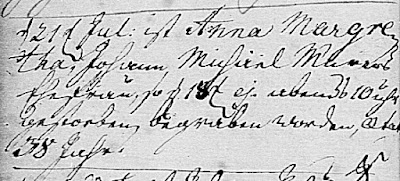
And question 3, when did Johann Mürer's first wife die?
And the answer is ...
"21 Jul [1771] ist Anna Margaretha, Johann Michael Mürers Ehefrau 18t. ej. abends 10 Uhr gestorben begraben worden Alt 38 Jahre"

Another Latin abbreviation: "ej." stands for "ejusdem" which means "the same"

Translation is "Buried on 21 July 1771, Anna Margaretha, Johann Michael Mürer's wife, died on the 18th of the same month, age 38 years"

Well, I think since you hung in there with me, I will provide a portion of the 1849 map that shows the area that has been a part of this discussion as a reward. The fact that both of his wives came from some distance over the hills from Niederthalhausen makes me ponder the why of it. Most marriages took place between couples who lived within spitting distance of each other. Not that they would ever do that, but, I'll leave you to do the speculating about that--the reason for getting his wives from elsewhere, not the spitting thing.
Niederthalhausen is in the upper right. Oberngeis is in the bottom center and Mühlbach is just above center on the left. Hope it is legible for you.

'til next time, SRR